1 Corinthians 11:1-17 * as both chiasmus and parallelism
An Interactive Presentation of Thematic Symmetry (Chiasm / Parallelism)
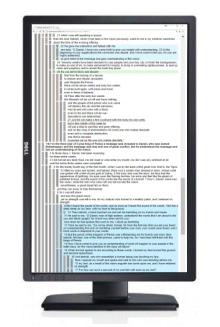
I've worked out two different versions of the design of this very profound passage of scripture. These are so compelling that I felt it necessary to present both of them here. I invite you to hover your mouse cursor over (or tap on, if using a touch-screen device) the presentation's lines of text and vertical bars to compare the colorful thematic pairings that are dynamically represented therein. For more instruction, read the Directions found at the bottom of the page.
You can find links to a video where I explain these two versions in this post on The Open Scroll Blog: Head Coverings: 1 Corinthians 11 Interactive * TWO VERSIONS
These interactive presentations are supplemental to this study, Head Covering: The Modeling of Divine Order (and associated video  )
)
The first presentation illustrates 1 Corinthians 11:1-17 as a chiasmus. To describe the basic structure most simply, what is written in verses 1-10a is repeated in verses 10b-17 in reverse order, as a 10+10 chiasm. This description is intended to help guide you as you explore this as you interact with the presentation on your screen.
The second presentation illustrates 1 Corinthians 11:1-17 as a parallelism. To describe the basic structure most simply, what is written in verses 1-2 is repeated in verses 3-17 in the same order, as a 2+2 parallelism. The bulk of the text is within what is technically labeled the a' section. The structure of a' can be described as a simple division, where what is presented in verses 3-7 is supported by what is written in 8-15. The basic structure of verses 3-7 is such that, what is written in 3-6b is repeated in 6c-7 in reverse order, as a 3+3 chiasm. The basic structure of verses 8-15 is such that, what is written in 8-10 is repeated in 11-15 in the same order, as a 2+2 parallelism.
Generated with the Chiasmatron 2000 (republished on May 7, 2024)
Attribution: Bob Schlenker
Explanation:
What you see above is an exhibit of the linguistic structure that appears throughout the Bible. The featured passage of scripture is straight from the Bible. Nothing has been added or removed or shifted out of sequence.
What's the point of studying this kind of symmetrical design? Firstly, be inspired by the awesome beauty and intricacy of the Author's Word. The structure also conveys meaning to those seeking knowledge and wisdom! In an elegant way, it suggests where the Author places emphasis. It presents context in a very refined manner that guides us to ask questions we would otherwise not be inclined to ask, subsequently leading us to profound insights we would not otherwise glean! How are the paired elements alike and how do they differ? In what specific ways do they compare? Why are they paired? Ask the questions prompted by the holy spirit as you're being informed by the structural comparisons.
Directions:
The interactive features will vividly illustrate the structural design. Pass your mouse cursor over the passage. Hovering over a vertical bar or a line of text will cause it to be highlighted together with its matching elements. If you see a bar or a line of text called out for special attention, click it to open a Commentary Window (which can be repositioned by dragging) and freeze the relevant background highlighting.
Tip: When a presentation is too big to fit on your device screen, you can make adjustments that will allow you to see the elements of interest together onscreen for easier comparison. Right clicking on a bar will collapse it to a single line - a very useful feature! Make your browser full screen - try F11. You can also adjust the zoom (ctrl- or ctrl+ to zoom out or in). If you have a monitor that rotates into a portrait display, leveraging that vertical real estate can be very useful.
For more explanation, see: About These Thematic Patterns
For more examples, see: Interactive Content